Kobudo and
Okinawa is a string of islands that lie between China and Japan and has been a common battle field for both its neighbors for many centuries. The Okinawan weapons are an integral part of Okinawan Martial Arts. In 1477 all weapons in Okinawa were banned and confiscated. This political move directly led to the development of two different fighting systems. Te, practiced by the nobility, is a form of empty hand combat; and Kobudo, developed by farmers and fishermen is a form of armed combat using simple farming tools and everyday implements as weapons. In both systems, training was conducted in strict secrecy. In some circles if one does not know weapons, one is not considered well rounded in Martial Arts.
|
 |
|
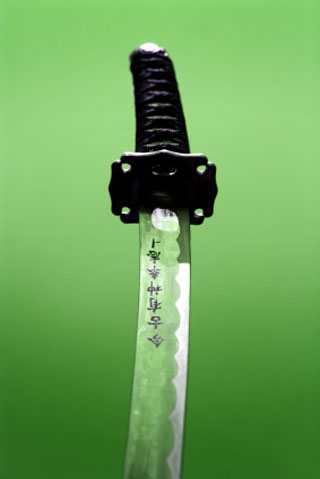
Japanese Weaponry Iaido - Kenjutsu Weapon Arts of the Samurai Iaido is the art of drawing and cutting with the Katana. This method of practice dates back to the Tokugawa Period 400 years ago. We study ZNKR Seitei Iaido, Muso Jikiden Eishin Ryu Iaido and Shimay Muso Ryu Iaido. Kenjutsu is the science of using the sword after it is drawn: the honing of battlefield techniques, timing, strategy, accuracy, strength, balance, etcetera. This art would have originated at the same time as the sword itself. We study Tachi Uchi No Karai from the Jikiden school of Iaido, and the sword of Miyomoto Musashi, Niten Ichi Ryu. Filipino Weapons (Escrima, Kali, Arnis) Escrima (which means to skirmish) is a Filipino Martial Art which has been traced back to the 9th century. When the Spanish first invaded the Philippines in the 16th century, their steel swords and armour proved no match for the Filipinos swift, elusive, and vicious sticks. The turbulent land saw many battles. The Filipinos learned new techniques from each invading force and developed a complex fighting system using empty hands, swords, sticks, clubs, staffs, lances, and knives. Eventually the Spanish managed to subdue the Filipinos by use of firearms, and thus conquered the land. In 1764, when Spanish control was complete, the practice of Escrima was outlawed; however, many of its movements were preserved in "folk dances". In Escrima training practitioners first learn weapons before progressing to the weaponless techniques of hand and foot. The first weapon is usually the stick or the dagger. Systems include the sinawali sticks (drills using two sticks usually about 30 inches long), single or double dagger methods, and espada y daga, the stick and dagger method. Escrima was brought to the USA and Hawaii in the early 1900's by Filipino college students, farm workers merchant marines, and dock workers. Jack Santos, an Escrima master, formally introduced the art to the USA in 1909. He was followed by numerous Escrimadores, but the art was then highly secretive. The non-Filipinos who learned the art did so through their Filipino friends. Today especially through the efforts of Dan Inosanto who has helped spread it world wide. |
